
MercuryRec
€119.00
- Description
Description
VST3 – AU – AAX

€119.00
Rectification from Another Planet
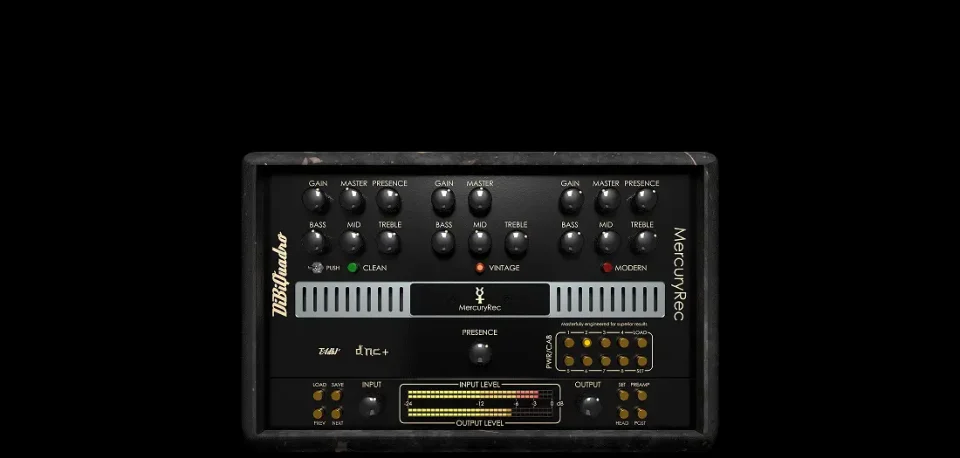
MercuryRec is a highly accurate software reproduction – developed with DiBiQuadro proprietary technology – of a guitar amplifier famous for its rectification modes, which is, despite of its undisputed reputation in the Heavy Metal environments, capable of nearly any possible musical style. With the original amp being used on countless of records and many genres, in the same way MercuryRec can cover a wide variety of tones: from Blues and Fusion, to Hard Rock and of course Metal.
MercuryRec is not just a simple replica of the 3 channels version but instead a “2 Channels + 1”: the high gain Vintage and Modern schematics recreate the old 2 channels vibe while the Clean is taken from the more recent 3 channels models.
Engage MercuryRec with the certainty that you are getting the same nuances of the real thing in the digital domain, and keep in mind: with the additional tweak section that only DiBiQuadro provides you can add a unique touch and finally get your very own personal sound!
Non-Plus-Ultra Preamp
Non-Plus-Ultra Preamp represents the perfect approach to circuit modeling. MeruryRec preamp features a built-from-scratch 64-bit engine which is based on general purpose hi-quality algorithms and the most recent non-linear models. Special care has been taken in defining the Non-Linear Solver to ensure maximum quality and realism, without losing details in favor of performances (Double-Precision Non-Linear Computing).
Our Non-Plus-Ultra reproductions bring a completely new philosophy to the table: being able to shape your tone by giving total access to the circuit components. Managing each gain stage level, shaping the tone-stacks or modifying the tubes characteristics: there is virtually no limit to what you can achieve with our plugins!
Power Amp Distortion & Headroom
The HEADROOM section lets you shape the behavior of the power stage, from clean headroom to full saturation.
You can define how and when the power amp starts to distort, choose different clipping characters, and adjust the interaction between pre and post gain stages.
Pwr/Cabs: Non-Linear Convolution
Before describing our solution, let’s talk about what everyone else does: the commonly spread approach of the “single IR” to reproduce a cabinet is nothing more than a digital clean equalizer. Which means: non-linearities are not reproduced at all. Competitors generally model power amps to introduce harmonic distortion, but they totally omit the non-linearities coming from the speaker, the microphone and the mic preamp. While these can be considered somehow negligible for some types of high wattage speakers when dealing high gain sounds, it is essential when the speaker breaks up. Furthermore, sometimes solid state power amps are used to sample cabinet, speakers and mikes, but these power amps, despite being considered “neutral”, have their own “footprints” due to the different impedance, so the interaction with the speaker is noticeably different when compared to a classic tube power-amp.
Another limit of many well-known amp simulations is the complete absence of power amp clipping.
As DiBiQuadro we implemented our own version of Non-Linear Convolution (NLC) to reproduce all the final stages of a miked amplifier. We use to call Pwr/Cab a chain made of:
- a tube power amp
- a cabinet/speaker
- a microphone
- and a high-end studio preamp

Double-Precision Non-Linear Computing and Convolution
Pwr/Cabs List
MercuryRec_000_100W_6L6
MercuryRec_000_V_100W_6L6
MercuryRec_001_100W_6L6_60A_1_T75_57_A12C
MercuryRec_001_V_100W_6L6_60A_1_T75_57_A12C
MercuryRec_002_100W_6L6_60A_1_T75_201_A12C
MercuryRec_002_V_100W_6L6_60A_1_T75_201_A12C
MercuryRec_003_100W_6L6_60A_1_T75_421_A12C
MercuryRec_003_V_100W_6L6_60A_1_T75_421_A12C
MercuryRec_004_100W_6L6_60A_4_T75_57_A12C
MercuryRec_004_V_100W_6L6_60A_4_T75_57_A12C
MercuryRec_005_100W_6L6_60A_4_T75_201_A12C
MercuryRec_005_V_100W_6L6_60A_4_T75_201_A12C
MercuryRec_006_100W_6L6_60A_4_T75_421_A12C
MercuryRec_006_V_100W_6L6_60A_4_T75_421_A12C
MercuryRec_007_100W_6L6_60A_2_V30_57_A12C
MercuryRec_007_V_100W_6L6_60A_2_V30_57_A12C
MercuryRec_008_100W_6L6_60A_2_V30_201_A12C
MercuryRec_008_V_100W_6L6_60A_2_V30_201_A12C
MercuryRec_009_100W_6L6_60A_2_V30_421_A12C
MercuryRec_009_V_100W_6L6_60A_2_V30_421_A12C
MercuryRec_010_100W_6L6_60A_3_V30_57_A12C_A
MercuryRec_010_V_100W_6L6_60A_3_V30_57_A12C_A
MercuryRec_011_100W_6L6_60A_3_V30_201_A12C_A
MercuryRec_011_V_100W_6L6_60A_3_V30_201_A12C_A
MercuryRec_012_100W_6L6_60A_3_V30_421_A12C_A
MercuryRec_012_V_100W_6L6_60A_3_V30_421_A12C_A
MercuryRec_013_100W_6L6_60A_3_V30_57_A12C_B
MercuryRec_013_V_100W_6L6_60A_3_V30_57_A12C_B
MercuryRec_014_100W_6L6_60A_3_V30_201_A12C_B
MercuryRec_014_V_100W_6L6_60A_3_V30_201_A12C_B
MercuryRec_015_100W_6L6_60A_3_V30_421_A12C_B
MercuryRec_015_V_100W_6L6_60A_3_V30_421_A12C_B
MercuryRec_025_100W_6L6_M212_V30_57_A12C_A
MercuryRec_025_V_100W_6L6_M212_V30_57_A12C_A
MercuryRec_026_100W_6L6_M212_V30_201_A12C_A
MercuryRec_026_V_100W_6L6_M212_V30_201_A12C_A
MercuryRec_027_100W_6L6_M212_V30_421_A12C_A
MercuryRec_027_V_100W_6L6_M212_V30_421_A12C_A
MercuryRec_028_100W_6L6_M212_V30_57_A12C_B
MercuryRec_028_V_100W_6L6_M212_V30_57_A12C_B
MercuryRec_029_100W_6L6_M212_V30_201_A12C_B
MercuryRec_029_V_100W_6L6_M212_V30_201_A12C_B
MercuryRec_030_100W_6L6_M212_V30_421_A12C_B
MercuryRec_030_V_100W_6L6_M212_V30_421_A12C_B
Shaper
The input signal can be processed by activating a shaper before the preamp. This block allows to select one of the following:
- a Low Cut
- a Mid Boost
- a Graphic Equalizer
- a Parametric Equalizer
- a Compressor
- an Overdrive circuit
- a Distortion circuit
Wah, Overdrive & Distortion — Fully Tweakable!
All DiBiQuadro amp simulations include the following effects, fully tweakable at component level:
- A beautifully voiced Wah effect. The frequency parameter can also be automated via your DAW.
- An Overdrive with two modes: TS (symmetric clipping) and SD (asymmetric clipping).
- A Distortion with three modes: MDP (Distortion+ style), and 250/308 (Classic Preamp) modes.
Both Overdrive and Distortion allow to select the type of diode:
- Silicon
- Germanium
The diode characteristic and topology (only positive, only negative, one against one) can also be modified.
Automations
Every knob, button and state of the Preamp and PwrCab sections can be automated in your DAW. This provides a new level of integration of DiBiQuadro plugins with the time-based events of your project.
Audio Samples
We pour our passion into achieving the perfect representation of the hardware. Don’t just take our word for it—let your ears be the judge.
Reverb and delay are not included in the product. They are used for demonstration purposes only.
MercuryRec CLEAN
Original Hardware CLEAN
MercuryRec CLEAN + Rev
Original Hardware CLEAN + Rev
MercuryRec PUSH
Original Hardware PUSH
MercuryRec PUSH + Rev
Original Hardware PUSH + Rev
MercuryRec VINTAGE
Original Hardware VINTAGE
MercuryRec VINTAGE Stereo
Original Hardware VINTAGE Stereo
MercuryRec VINTAGE Brighter
Original Hardware VINTAGE Brighter
MercuryRec VINTAGE Brighter Stereo
Original Hw VINTAGE Brighter Stereo
MercuryRec VINTAGE Lead SL
MercuryRec VINTAGE Lead SL + Rev + Delay
MercuryRec MODERN
Original Hardware MODERN
MercuryRec MODERN Stereo
Original Hardware MODERN Stereo
MercuryRec MODERN Brighter
Original Hardware MODERN Brighter
MercuryRec MODERN Brighter Stereo
Original Hw MODERN Brighter Stereo
Standalone Application
In addition to using it as a plugin in your favorite DAW, you can also run it as a standalone application and play in real time directly from your operating system, with no DAW required.
The Renderer
The Renderer is another standalone application to process an input wave file in OffLine mode. It can be invoked via command line too. Its purpose is to render long and processing demanding configurations (e.g. high upsampling).
System Requirements
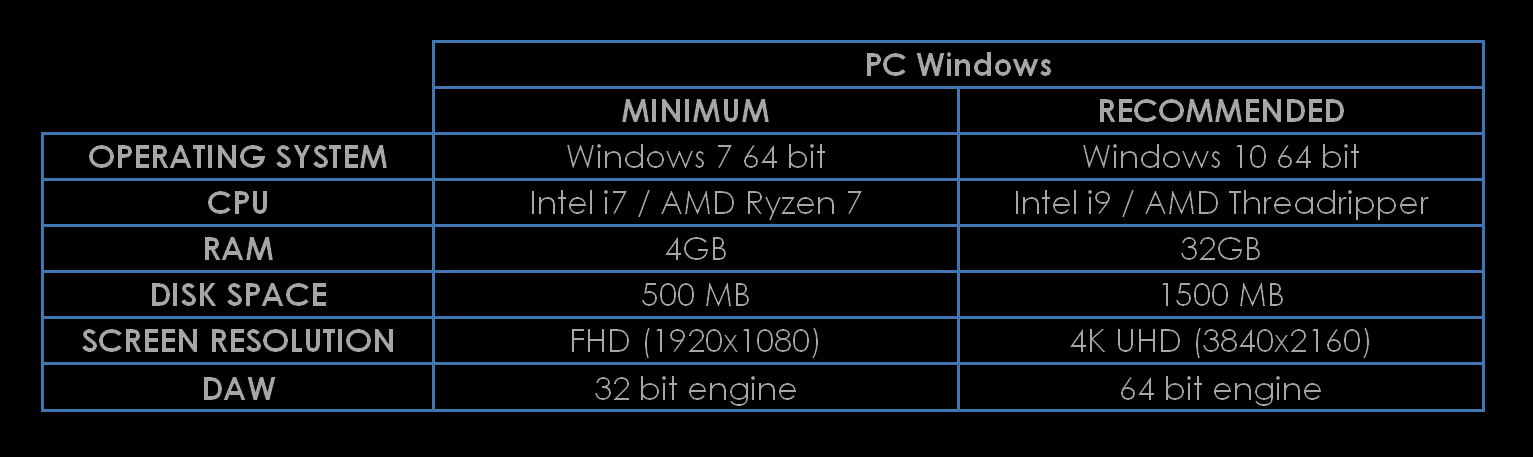
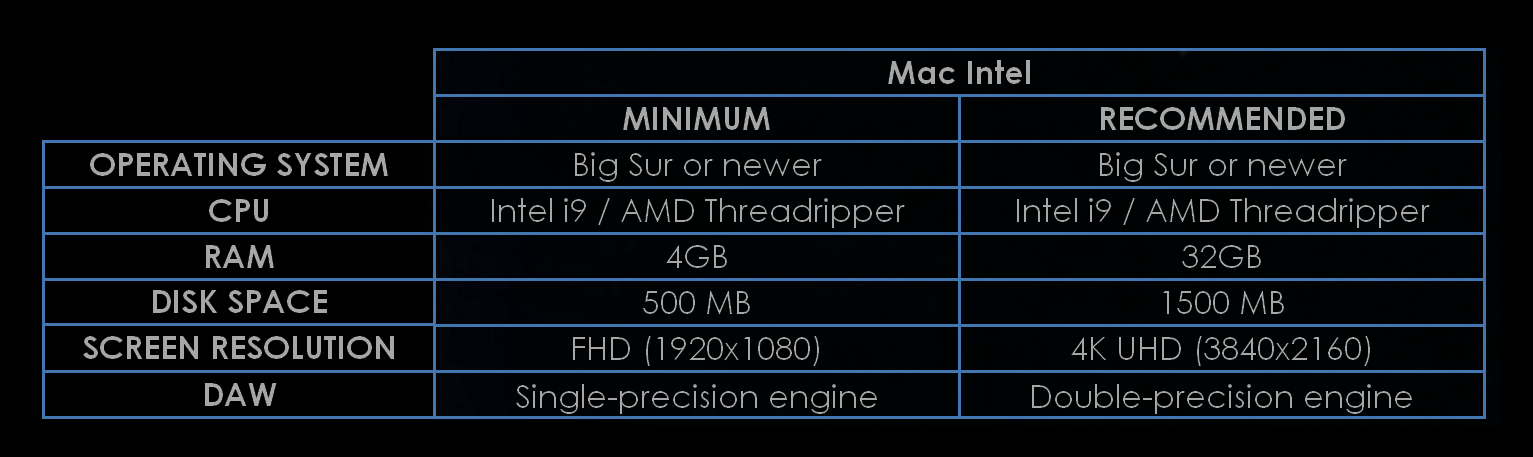
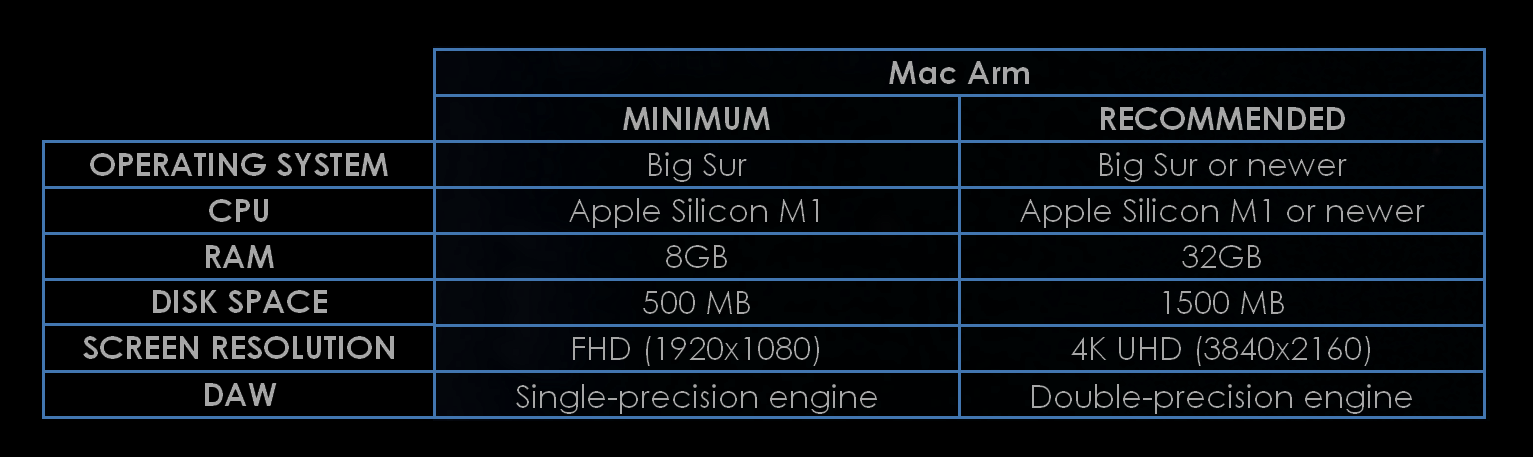
MercuryRec is distributed for Windows 64-bit and MacOs 64-bit Intel and Arm (Apple Silicon), in 2 formats:
- Plugin in VST3/AU/AAX 64 bit format;
- Renderer in Windows/macOs executable
We recommend to demo the 15-days trial version before any purchase. Requirements are reported in the tables below.
Formats and operating systems different from the ones specified above are not supported yet.
DAW compatibility
MercuryRec can be used on the most popular DAWs (digital audio workstation). Here is a list of tested DAWs:
- Cockos Reaper (Windows/macOs)
- Presonus Studio One (Windows/macOs)
- Steinberg Cubase/Nuendo (Windows/macOs)
- Logic Pro X (macOs)
- Cakewalk Bandlab/Sonar (Windows)
- Avid Pro Tools (Windows/macOs)
- Ableton Live (Windows/macOs)
For Ableton Live on Windows 11 the following action is necessary to display the GUI correctly: right click the Live executable (or shortcut) / Properties / Compatibility / Change high DPI settings / Check “Override high DPI scaling behavior. Scaling performed by:” / change drop down to “Application” / Apply.
In Ableton Live, right-click the plug-in in the browser and disable Auto-Scale Plug-In Window.
Downloads
To install/authorize MercuryRec please use DiBiQuadro Center. If you have any issue please contact us.